This May Be the Best Time in History to Build — If You're Building the Right Thing
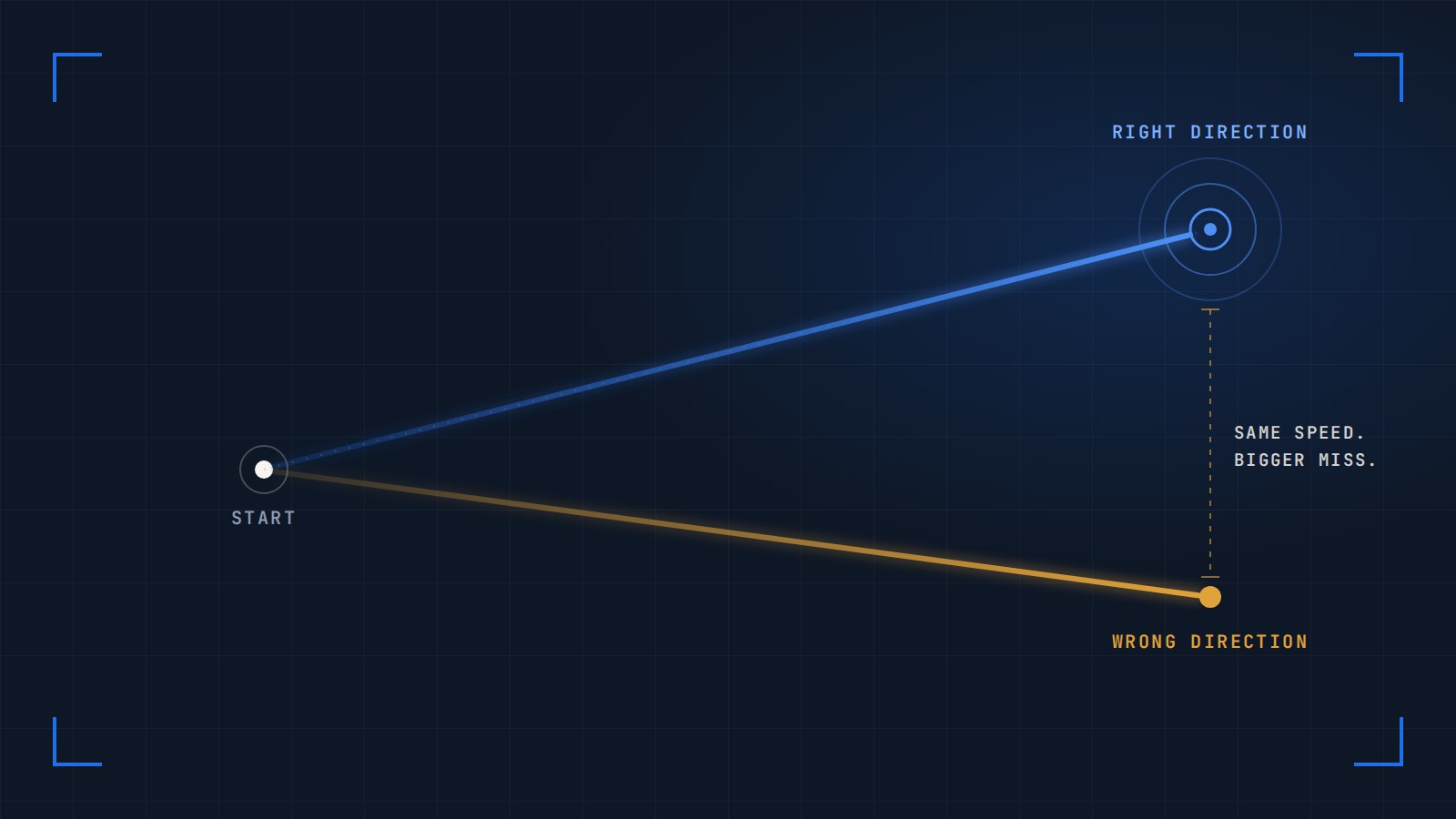
Speed is table stakes. Your real advantage is strategic clarity. The danger isn't moving too slowly — it's scaling something that was never built to last.
There has never been a better time to build.
There has also never been an easier way to pour effort into the wrong thing.
AI didn't just hand us new tools. It collapsed time. Work that used to take six months now takes six weeks — sometimes six hours.
Ideas surface overnight. Products reach market in days. Demand shifts under your feet. And whatever edge you had erodes before you've finished celebrating it.
That's not a warning. It's the new physics. And acceleration doesn't simply reward the quick — it magnifies whatever direction you were already headed.
Velocity is a multiplier, not an edge
Execution has gone cheap. The tools are in everyone's hands, distribution costs almost nothing, and an idea can circle the world before lunch.
Sit on something and someone else ships it first. Moving quickly still matters — but it's no longer scarce. And the moment a capability becomes common, it stops being an advantage.
So treat velocity for what it actually is: a multiplier. Aim it at a sound direction and it compounds your gains. Aim it at a flawed one and it compounds the damage just as efficiently.
The operators who win aren't simply the fastest. They're the ones who point themselves the right way — and do it again and again.
The question that comes first
Before you ask "How do I grow this?" ask the harder one: "Is this even worth growing?"
Will this model still hold up in twelve to eighteen months? The real question isn't whether AI replaces you. It's sharper than that:
- Is my offer drifting toward commodity?
- Is my distribution one algorithm change away from collapse?
- Will AI make what I sell trivial to produce — and therefore cheap?
- Is this easier to copy than it was half a year ago?
If you can't answer cleanly, your priorities have to change. In a compressed market, a small misalignment doesn't stay small. It compounds.
Structure is how your business actually makes money
When I say structure, I don't mean your website or your stack. I mean the machine underneath — the way the business genuinely works.
Who you serve. The problem you solve. Why they pick you over the alternative. How you win customers and how you keep them. How the money actually gets made.
That's structure. Everything else — tools, ads, AI, automation — is scaffolding bolted on top.
AI lowers the cost of launching, testing, and shipping. But a weak foundation doesn't get fixed by moving quicker; it just fails sooner and louder. A strong one turns every bit of momentum into leverage.
A confused offer doesn't get clearer under pressure. Thin margins don't fatten. Fragile distribution doesn't toughen up. Acceleration only drags the truth into view ahead of schedule.
That's the whole distinction.
The real game: iterate, then reinforce
Here's the part most people skip past. The winners don't bet everything on one durable idea at the start. They:
- Generate more ideas than they can use
- Test them without mercy
- Cut the weak paths early
- Lean hard into anything showing signal
- Build permanence around what survives
A faster pace buys you more attempts. Judgment decides which attempts are worth keeping. Structure makes the keepers permanent.
Plenty of people can ship quickly. Very few turn a stream of attempts into compounding leverage.
Run two engines
In a compressed market, sharp operators work two tracks at once.
Engine 1 — the cash engine. Reinforce what already works. Sharpen the positioning, widen the margins, deepen the loops that reliably pay.
Engine 2 — the future engine. Place small bets. Ship MVPs. Drive down the cost of each experiment. Confirm signal early — and kill what doesn't show it.
This isn't shiny-object chasing. It's widening your surface area for discovery while keeping the core protected.
Attempts open doors. Structure turns the open doors into leverage.
The twelve-to-eighteen-month test
Before you sink real time or capital into something, run it through one filter: Will this still matter a year and a half from now? Will it compound? Or is it just motion dressed up as progress?
If its shelf life is short: take the value and move on. Don't overbuild. Protect the capital.
If it looks durable: codify it, systematize it, and build real infrastructure around it.
That's how momentum becomes advantage instead of expensive distraction.
This isn't doom — it's leverage
This may be the most opportunity-rich moment in business history. You can test, deploy, and reposition in a fraction of the time anyone could before.
But the people who come out ahead won't just move quickly. They'll raise their idea velocity, sharpen their judgment, double down on what proves durable, build systems around the signal, and turn hard-won wins into permanent advantage.
They won't just build quickly. They'll build, test, reinforce — and compound.
The real edge
In a world where everyone can move fast, motion is ordinary and execution is ordinary. Compounding is the rare thing.
The edge now belongs to the operators who can generate momentum, hold their judgment steady under pressure, and convert winning ideas into durable structure.
Pace creates the opening. Structure turns the opening into leverage. And leverage, reinforced over time, is what actually wins.
Keep reading
Capacity Without Headcount: How AI Agent Teams Actually Work
A team you never hired can plan, execute, and check complex work in hours. That's capacity without headcount — and verification is the architecture that decides whether you can trust what comes back.
Read This Before You Implement AI in Your Business
Almost everyone buys the AI tool before diagnosing the problem — and the data shows how badly that ends. Here's how to find your real first move.